Delta or tadpole? What each layout does in a turn, on a crowned road and at walking pace
Carriage House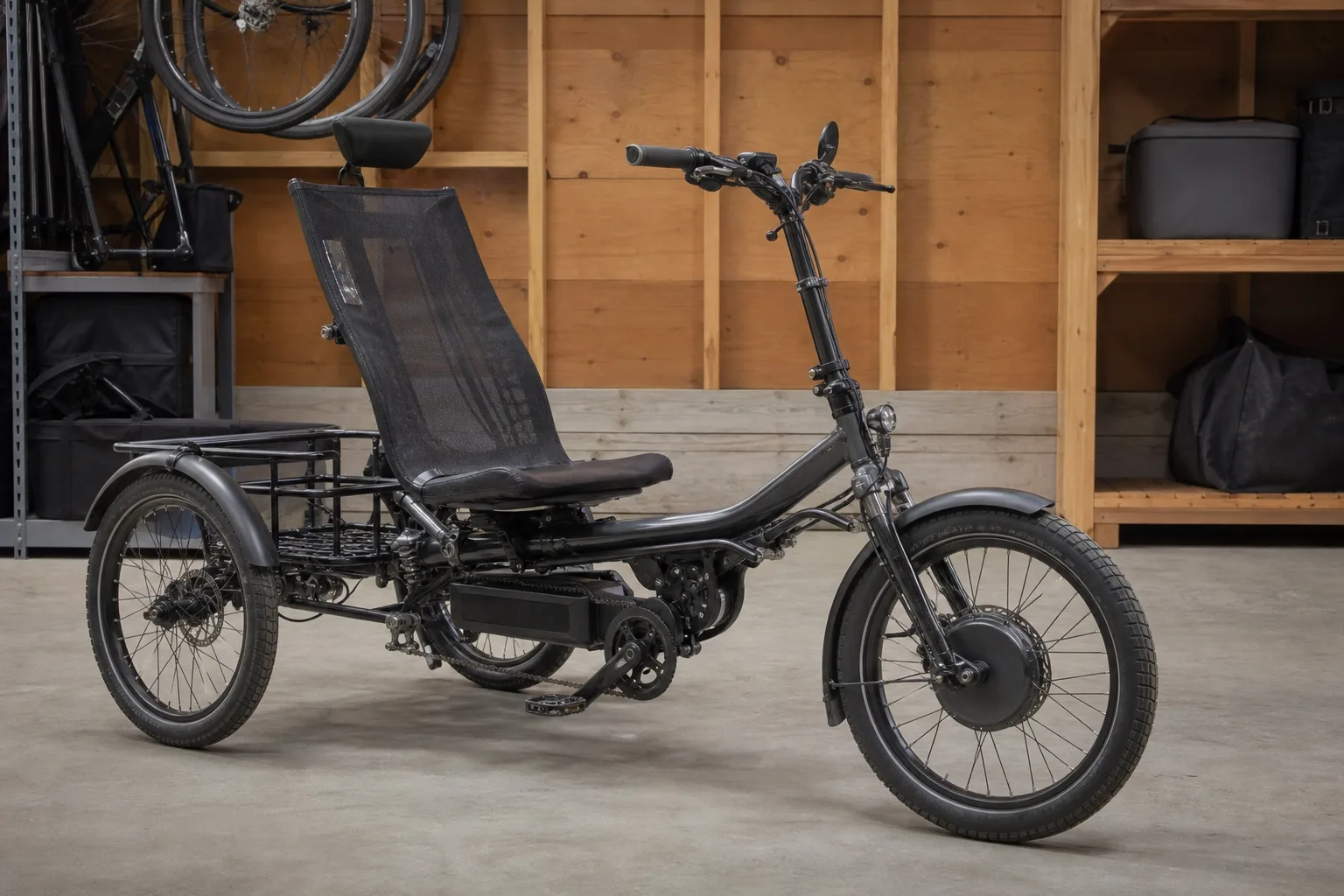
The layout question gets settled for most buyers by whatever the local shop stocks, and then it reasserts itself six weeks later on the first fast right-hander at the bottom of a hill. Delta means one wheel in front and two behind. Tadpole means two in front and one behind. The difference is not cosmetic, and it is not mainly about looks or cargo capacity, though both follow from it. It is about where the mass sits relative to the triangle the three contact patches make, and that geometry governs everything a rider feels in a corner.
What actually happens when you turn
A trike does not lean unless it is built to, so cornering force has to be resisted by track width instead of body english. Picture the triangle drawn between the three contact patches: stability depends on how far the center of mass sits inside that triangle in the direction you are being pushed. On a delta, a right turn throws weight toward the outside rear wheel, and the triangle narrows toward the single front wheel, so the margin shrinks exactly where the rider's mass already is. On a tadpole, the wide pair is in front, ahead of the rider, and the triangle broadens toward the load. That is why tadpoles generally hold a given speed through a corner more calmly, and why delta riders learn to brake earlier and enter wider.
Camber, crown and the low-speed case
American residential streets are crowned to shed water, and most bike lanes sit on the steepest part of that crown. A three-track vehicle cannot ignore camber the way a two-wheeler can, because the frame stays upright while the road tilts underneath it, and the machine tries to steer downhill. Tadpoles show this as a steady pull at the handlebars that you correct with light, constant pressure. Deltas show it more as a sense of the rear stepping toward the gutter. Both are manageable once expected. At walking pace, the delta earns its keep: the tall, upright seating and short front end make it easier to put a foot down, thread a garage door, and creep along a sidewalk beside someone on foot.
What a tilting mechanism adds, and what it asks for
Tilting trikes let the two-wheel pair pivot so the frame leans into a turn, restoring some of the cornering behavior of a bicycle while keeping the standing stability of three wheels. Done well, it flattens the camber problem almost completely and raises the speed at which a corner feels secure. It also introduces a linkage, bushings or bearings, and in most designs a lock that holds the frame upright when parked or maneuvering. That is three or four more wear items, a lock that must be engaged and released reliably, and a service question the buyer should answer before purchase rather than after. The Consumer Product Safety Commission oversees safety requirements for bicycles sold in the United States, and a manufacturer that engages seriously with that framework tends to document its linkage clearly.
The checks worth making before money moves
Measure track width at the widest point, not the tire sidewalls, and compare it to the narrowest door on the route from street to storage. Ask which wheels the brakes act on, since a delta with rear-only braking behaves very differently on a wet descent than one with a front disc. Ask whether the driven rear wheels use a differential or a single powered wheel, because a single powered wheel pushes the trike sideways slightly under hard acceleration out of a turn. Sit on it, stationary, and lean hard to one side to feel where the resistance builds. Then ride the crowned street outside the shop, in both directions, at the speed you actually plan to travel.
Matching the layout to the route you already ride
A rider whose week is short trips at ten to twelve miles an hour, with tight turns, curb cuts and a narrow side door, will get more from a delta's compact front end and easy mounting than from any cornering advantage. A rider with a long descent, a crowned arterial and a steep driveway will feel the tadpole's wider front track on every trip, and may find a tilting design worth the extra maintenance. The honest way to choose is to name the three hardest moments in a typical week and pick for those, since the easy miles are comfortable on either layout.
Ride both on the same afternoon if you possibly can, on the same road, and pay attention to what your hands are doing rather than what the specification sheet says.
| The contact patch triangle | Every trike's stability comes from the triangle drawn between its three tires and where the rider's mass sits inside it. The wide side of that triangle should face the direction the cornering force pushes. |
| Delta at the curb | One front wheel means a narrow leading edge, which makes curb cuts, gate gaps and tight garage entries noticeably easier. Riders who dismount often tend to prefer it. |
| Tadpole in fast corners | With the wide pair ahead of the rider, a tadpole keeps more margin as weight shifts outward mid-turn. The practical result is a higher comfortable cornering speed on the same road. |